


UW wins Clean Snowmobile Challenge
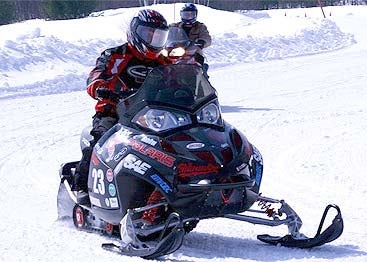
Electric-powered sled runs 17.2 miles
A team of students from the University of Wisconsin-Madison dominated the competition at the SAE Clean
Snowmobile Challenge with their electric-powered sled. Hosted by Michigan Technological University, the Clean
Snowmobile Challenge is the Society of Automotive Engineers’ newest collegiate design competition. More than 160
students from 14 universities in the United States and Canada participated in the event, in which Arctic Cat,
Ski-Doo, Polaris and Yamaha all were ‘gold sponsors.’
The engineering students were tasked with taking a stock snowmobile and reengineering it to reduce emissions and
noise while maintaining or improving performance. The vehicles had to complete a 100-mile endurance run and were
checked for fuel economy, noise, emissions, rider comfort and handling. The sleds were also judged for curb appeal.
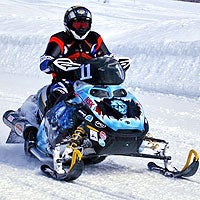
UW Madison completed 27 laps of the Keweenaw Research Center’s 0.6-mile test track on March 13 in Houghton, Mich.
Including the one mile trip to the track itself, the sled ran for 17.2 miles. Teams were challenged to run their
reengineered snowmobiles on the test track for as many laps as possible until they could no longer safely sustain a
pace of 20 miles per hour.
UW Madison’s entry used a Delphi electric motor (once used by General Motors in its EV1 electric car) powered by
84 28-volt lithium-ion batteries and is capable of running up to 20 miles on a single charge.
“The sled ran fine,” says UW Madison rider Nick Rakovec. “We had a good, robust design with good cooling, and our
direct drive system helped with our efficiency.”
Rakovec and the rest of the UW Madison team believe the sled could have completed several more laps, but with the
victory secured they chose to quit so that recharging the battery for later events was more efficient.
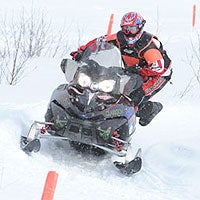
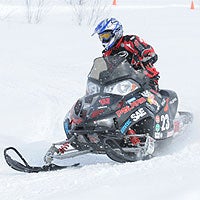
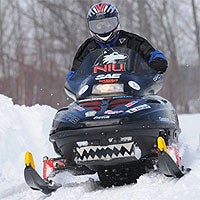
With the win, UW Madison has earned the chance to send team members, and
potentially the winning sled, to the National Science Foundation’s (NSF) Summit Station in Greenland. Researchers in
the Arctic station use electric vehicles when traveling across the ice, because emissions can contaminate samples
taken from ice and the air.
“It’s an incredible machine,” says Tracy Dahl of Polar Field Services, who was representing the NSF. “The thing
rips.”
Three other teams competed in the zero-emissions division of the SAE Clean Snowmobile Challenge. The South Dakota
School of Mines and Technology completed 7.9 miles, Clarkson University’s entry ran for 4.6 miles and McGill
University’s snowmobile completed just 1.7 miles before its engine started smoking.
UW Madison’s zero emissions sled also won the Society of Automotive Engineers Award for Best Design in its class,
first place for the Kreider and Associates Award for Best Paper, the DENSO Award for Best Ride, the Veco Polar
Resource Range Event Award, and the Caterpillar Corporation Innovation Award.
Clarkson University’s three person team, including two freshmen, took home top prize in the internal combustion
division of the competition. “We used a very simplistic design based on a Polaris FST chassis,” says team leader
Pete Giovenco.
“We just wanted to make it to the competition, but it’s been the experience of a lifetime.”
Event co-organizer Jay Meldrum, director of the Keweenaw Research Center, says Clarkson’s simple design paid off.
“They just boosted the pressure on their fuel pump and added a catalytic converter,” says Meldrum. “They deserved to
win.”
Clarkson also won the Lotus Engineering and Horiba Instruments Award for Lowest Emissions and the EMITEC Award
for Best Value, which balances cost, fuel economy and performance.
All entries in the challenge’s internal combustion division were required to run on biofuel, and most chose E85
ethanol.
In addition to its victory in the internal combustion division, Clarkson University was also one of four teams to
complete the Endurance Run. University of Wisconson-Platteville, Kettering University and Northern Illinois
University all managed to complete the run.
The Endurance Run required teams to get enough efficiency out of their ethanol-powered sleds to travel 100 miles.
Since alcohol contains less energy than gasoline, vehicles powered with E85 generally burn more fuel per mile.
“This proves that it can be done,” says Meldrum. “We’ve shown that you can go 100 miles on E85 on a real trail.
We even had a first-year team, Northern Illinois, finish, and that’s pretty impressive.”
Minnesota State University at Mankato, State University of New York at Buffalo, University of Idaho and
University of Wisconsin-Madison dropped out with mechanical difficulties during the first leg of the Endurance Run,
which includes laps around a snow-covered track.
Michigan Tech’s sled reached the second leg, which is a trail ride north, but had to drop out with a mechanical
problem. École de Téchnologie Superieure, of Montreal, ran out of fuel on the trail.
Michigan Tech will coordinate the SAE Clean Snowmobile Challenge in 2009.
Related Reading:
Students compete in
Clean Snowmobile Challenge


 Your Privacy Choices